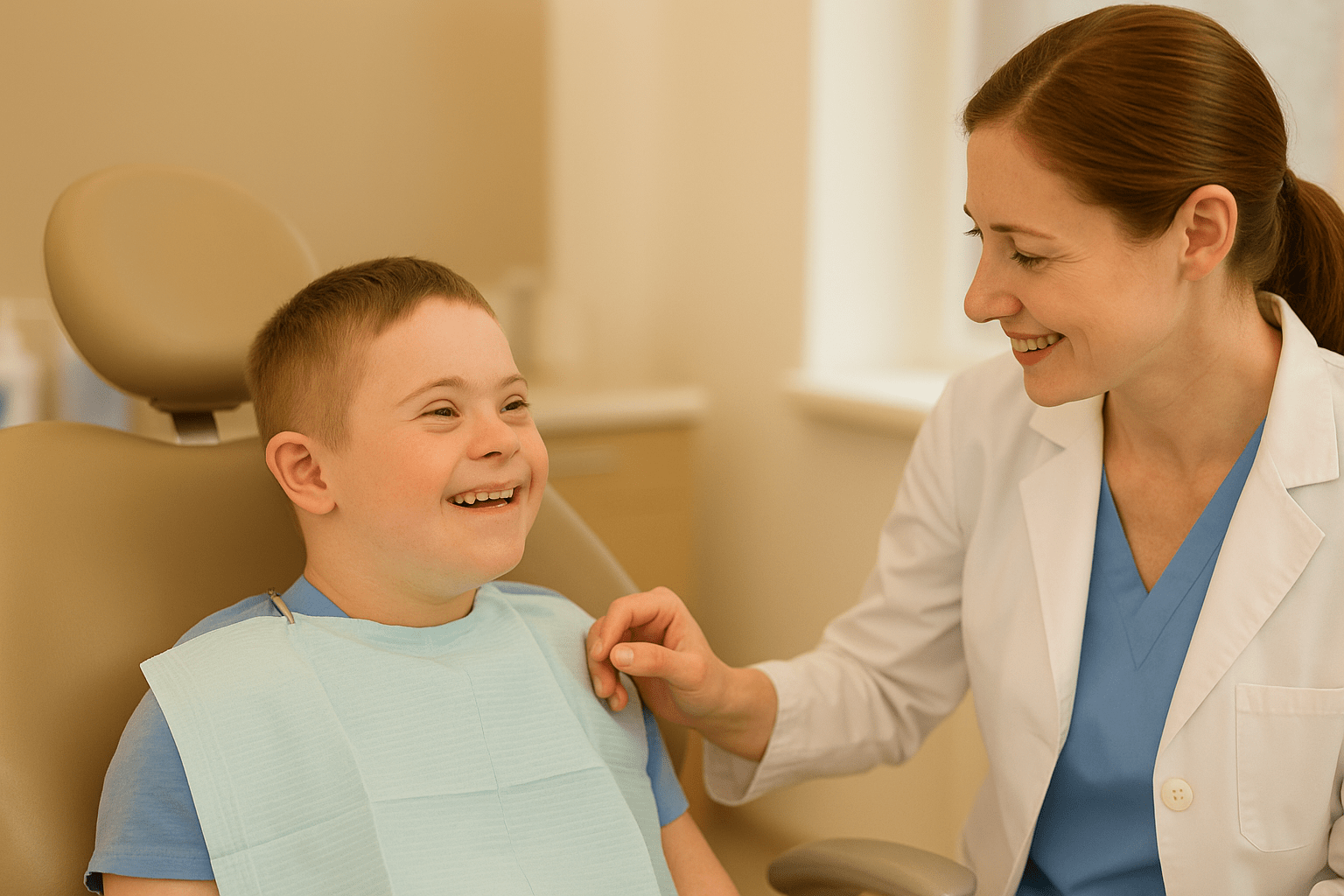
You might be feeling a mix of worry and guilt every time a dental appointment comes up. You know your child or loved one needs care from a Gettysburg dentist, yet the idea of bright lights, new faces, strange sounds, and someone working inside their mouth can feel overwhelming. Maybe you have already tried a visit that ended in tears, a meltdown, or a rushed exam that did not feel like real care at all.end
Before all this, dental visits might have seemed simple. You called, you booked, you went. Now everything feels more complicated. You are not just asking “When is the next cleaning?” but “Will this dentist understand my child’s autism?” or “Can they handle my parent’s mobility issues or dementia?” or “Will they judge us if things do not go smoothly?”
So, where does that leave you? In a place where you need a family dentist who not only knows teeth, but who also knows how to adapt care for patients with special health needs. The good news is that many family dentists are quietly doing exactly that. They are changing the environment, the communication, and even the way treatment is delivered so that people with disabilities or medical conditions can get safe, respectful, and effective care.
Here is the short version. A thoughtful family dentist can adjust almost every part of a visit. From scheduling longer appointments, to using visual supports, to offering desensitization visits, to working with medical teams, to modifying tools and techniques. Your job is not to “make your loved one fit the dentist.” Your job is to find a dentist who is willing to fit the care around your loved one.
Why dental visits feel so hard for patients with special health needs
When you care for someone with a disability or complex medical condition, you are always planning ahead. You think about medications, mobility, behavior triggers, sensory overload, and safety. A dental office can challenge each of those at once.
For example, imagine a teenager with autism who is very sensitive to sound and touch. The dental office has phones ringing, suction noise, and people moving quickly. Lying back in a chair, having hands in their mouth, and not being able to speak clearly can trigger fear or panic. A routine exam can quickly feel like a crisis.
Or picture an adult with cerebral palsy who uses a wheelchair. Transferring to a dental chair may be painful or even unsafe. They might have difficulty keeping their mouth open for long periods, yet still need complex treatment. Without planning, even a simple cleaning can turn into a physically exhausting event.
There are also medical concerns. People with heart conditions, bleeding disorders, or who take multiple medications may face higher risks during dental care. Caregivers often feel torn. They know ignoring dental issues is dangerous, yet they also fear procedures that might affect overall health.
Because of this tension, you might wonder if it is easier to delay care or skip visits. That is where an experienced family dentist who provides special needs dental care can change the story.
How family dentists adapt care to meet unique needs
A skilled family dentist does not start with the teeth. They start with the person. They ask questions, listen, and then build a plan around abilities, preferences, and medical realities.
Here are some of the ways family dentistry for patients with disabilities often looks different from a standard visit.
1. Extra time and flexible scheduling
Many patients with special health needs do better when they are not rushed. A dentist may schedule a longer appointment, choose a quieter time of day, or break treatment into several shorter visits. This allows more breaks, time to explain each step, and room for behavior support without pressure.
2. Sensory and environment adjustments
Small changes in the office can make a big difference. Lights can be dimmed. Music or TV can be turned off or changed. Weighted blankets, sunglasses, or headphones may be offered. Some dentists provide a “quiet room” or a more private space so the patient is not overwhelmed by other activity.
Resources like the Washington State oral health guidance for patients with special needs outline many of these sensory and behavioral supports, which more family dentists are now adopting.
3. Communication that fits the patient
Communication is often the key. A thoughtful family dentist will use simple language, visual schedules, social stories, or demonstrations. They may show each tool before using it, practice “open wide” without instruments, and check in often for signs of discomfort.
For patients who are nonverbal or who use devices, staff can learn how the person communicates best. Caregivers are invited to share phrases that calm the patient, topics they like, and warning signs that a break is needed.
4. Behavior supports and desensitization
Some dentists offer “practice visits” where nothing invasive happens. The patient may just sit in the chair, feel the bib, hear the suction from a distance, or count teeth with a mirror. These short, positive experiences build trust over time.
The Oklahoma oral health guide for people with special needs describes step-by-step approaches that help patients slowly accept care, instead of forcing everything into one stressful visit.
5. Medical coordination and safety planning
For patients with complex medical histories, a family dentist will often speak with the primary care doctor or specialist. They may review medication lists, ask about seizure triggers, or confirm whether antibiotics or special precautions are needed.
Some patients benefit from hospital-based dental care or advanced facilities. Centers like the Care Center for Persons with Disabilities Personalized Care Suite at Penn Dental Medicine were built for those who need hospital-level equipment, sedation options, or wheelchair accessible operatories. A local family dentist can help decide when referral to such a center makes sense.
Comparing your options for special health needs dental care
When you are deciding how to handle dental care, you may be weighing different paths. Do you try a standard office again? Do you look for a family dentist with special training? Do you wait for a hospital-based clinic? Each option has tradeoffs.
The table below offers a simple comparison to help organize your thoughts.
| Option | Pros | Cons | Best suited for |
|---|---|---|---|
| Standard family dentist with no clear special needs focus | Often nearby. Shorter wait times. May be lower cost. | Staff may lack training. Limited sensory or behavioral supports. Higher risk of stressful visits. | Patients with mild needs who handle new environments fairly well. |
| Family dentist experienced in special needs dental care | More flexible scheduling. Adapted communication. Environmental changes. Willing to coordinate with the medical team. | May be harder to find. Some services may still require referral. Visits can take longer. | Children and adults with developmental, behavioral, or medical needs who can be treated safely in an office with adjustments. |
| Hospital or specialized disability dental center | Highest level of medical support. Access to sedation or general anesthesia when needed. Full accessibility. | Long wait lists. Maybe farther from home. Insurance and cost can be more complex. | Patients with severe behavioral challenges, significant medical risk, or those who cannot tolerate care in a standard setting. |
This comparison is not about choosing the “perfect” option. It is about matching your loved one’s needs to the right level of support, and understanding that their needs may change over time.
Three concrete steps you can take right now
1. Create a simple “dental profile” for your loved one
Write down a one-page summary to share with any family dentist you contact. Include diagnoses, medications, communication style, sensory triggers, what usually helps, and what has gone badly in the past. Add any safety concerns, such as seizure history or heart conditions.
This small document can save you from repeating everything under pressure. It also shows the dental team you are a partner, not just a worried parent or caregiver.
2. Interview the dentist before booking a full visit
Call and ask specific questions about how they provide special needs dentistry. For example.
“Do you see patients with disabilities or complex medical needs regularly?”
“How do you handle sensory sensitivities or anxiety?”
“Can we schedule a shorter get-to-know-you visit first?”
“Are you able to coordinate with our doctor if needed?”
Pay attention not just to the answers, but to the tone. Do they sound rushed or annoyed? Or do they sound curious and open to adapting?
3. Plan the first visit as a “success practice,” not a full treatment day
If possible, set the first appointment with modest goals. Maybe the goal is simply that your loved one walks into the office, sits in the chair for a few minutes, and allows a quick look at their teeth. Even if no cleaning happens, that can still be a success.
Talk with the dentist ahead of time about what a “win” looks like. Bring comfort items, headphones, or visual supports. Afterward, celebrate the effort, not the outcome. Each positive experience makes the next visit easier.
Moving forward with more confidence and less fear
You carry a lot already. Managing daily care, school or work demands, appointments, and your own emotions is hard enough, and dental visits often feel like one more mountain to climb. You deserve a family dentist who understands that and who sees your loved one as a whole person, not a problem to get through quickly.
When a dentist adapts care for patients with special health needs, something important happens. Your loved one feels safer. You feel heard. Dental problems can be caught earlier, pain can be prevented, and long-term health improves.
You do not need to fix everything at once. Start with one phone call, one dental profile, one carefully planned visit. Use resources like the Washington State special needs oral health page, the Oklahoma guide for oral health for people with disabilities, or specialized centers such as Penn’s Care Center for Persons with Disabilities Personalized Care Suite to understand what is possible.
You are not asking for special treatment. You are asking for appropriate treatment. With the right family dentist by your side, that is a very reasonable thing to expect.